Expert Guide to Selecting eLearning Translation Partner Organizations
Navigate the complex landscape of global localization by identifying critical red flags and essential green flags.
Protect your international training investment by choosing a partner that prioritizes technical engineering, linguistic precision, and seamless learning management integration.
We go beyond literal translation by ensuring every trigger, variable, and interactive element functions perfectly within your specific learning management system. Our engineering team guarantees a flawless user experience for global learners.
Our linguists are subject matter experts who understand the nuances of your industry. This ensures that technical jargon remains accurate, which preserves the authority and educational value of your corporate training.
We adapt your content to align with local cultural norms and expectations. This depth of localization increases learner engagement and prevents misunderstandings that often arise from direct, literal word replacement strategies.
How to Choose an eLearning Translation Company: A Green Flag vs. Red Flag Guide.
The Stakes of Global Training: A Cautionary Tale.
Imagine the following scenario. You have invested 80,000 USD and 6 months of intensive labor into developing a perfect compliance course. To save costs, you hire the cheapest eLearning translation company you can find. The result is a catastrophe. Your international staff encounters culturally offensive examples, broken quiz links, and navigation buttons that do not function. Eventually, the LMS report shows that 90% of your global workforce failed the assessment.
The cost of selecting the wrong partner exceeds mere financial loss, as it compromises your reputation and the entire effectiveness of your training program. This guide serves as an insider due diligence checklist to help you avoid such partnerships and choose eLearning translation partner organizations that deliver excellence.
Section 1: The 5 Unforgivable Red Flags 🚩
When you select eLearning localization vendor candidates, certain behaviors indicate a fundamental lack of expertise. These deal-breakers suggest that a provider does not respect the complexity of modern educational technology.
1. They Quote by the Word, Not by the Project.
A significant red flag appears when a vendor provides a quote based solely on word count. This approach demonstrates that the provider views your course as a static document rather than a complex digital product. An eLearning module contains multimedia elements, intricate programming, variables, and specific testing requirements. A vendor who focuses only on words likely lacks the infrastructure to handle the technical layers of your project.
2. Their Portfolio Consists Entirely of PDFs and Websites.
Expertise in document translation does not translate to expertise in instructional design. If a corporate translation vendor cannot show evidence of working with interactive authoring tools, proceed with caution. You require a partner who understands the nuances of Articulate Storyline, Adobe Captivate, or Lectora. Without a proven track record in these tools, they will likely struggle with SCORM or xAPI integration, leading to functional failures in your LMS.
For more information on technical standards, visit our Oris translations E-learning pillar page.
3. Claims of 98% Accuracy via AI and Machine Translation.
If a company leads with the high accuracy of their AI or Machine Translation (MT) engines, they are likely cutting corners. Whereas MT has improved for simple text, it cannot handle the specific context of a course, UI strings, or deep cultural adaptation. Machine translation often fails to align with the visual cues on a slide, resulting in a disjointed learner experience. An authoritative eLearning translation agency selection process prioritizes human expertise over automated shortcuts.
4. Vague or Non-Existent QA Process Descriptions.
Quality Assurance (QA) is the backbone of localization. If a vendor cannot detail their specific testing stages, your quality is left to chance. A professional process must include three distinct layers:
- Linguistic Testing: Ensuring the translation is accurate and culturally appropriate.
- Functional Testing: Verifying that every button, trigger, and quiz works as intended.
- Cultural Testing: Confirming that imagery and examples resonate with the local audience.
To learn more about rigorous testing, visit the Oris Translations specified article on E-learning QA.
5. Absence of Subject-Matter Expert (SME) Translators.
Generalist translators are unsuitable for specialized e-learning content. Whether your course covers medical compliance, financial regulations, or technical engineering, the linguists must be Subject-Matter Experts. A generalist will frequently mishandle industry-specific jargon, which compromises the credibility of your training. Furthermore, technical inaccuracies can lead to safety risks or legal liabilities in a corporate environment.
Section 2: The 7 Essential Green Flags ✅
After identifying what to avoid, you must focus on the qualities of a true strategic partner. These are the indicators of professional competence and technical depth.
1. They Ask Detailed Questions About Your Tools and LMS.
A competent partner does not simply accept a file and promise a result. Instead, they inquire about your authoring tools, the version of the software used, and the specific requirements of your Learning Management System. This curiosity is a sign of technical competence. They understand that the file structure of a Storyline project differs significantly from a Rise 360 course.
2. Provision of a Clear, Multi-Stage Project Plan.
Professionalism is defined by process. A high-quality eLearning translation company provides a transparent roadmap. This plan should outline the extraction of text, the translation phase, the engineering integration, and the final QA cycles. Equally important is the inclusion of milestones for client review, ensuring that you remain informed at every stage of the project lifecycle.
3. Their Team Includes Dedicated Localization Engineers.
This is perhaps the most critical green flag. Localization is an engineering task as much as a linguistic one. Engineers ensure that the right-to-left text displays correctly in languages like Arabic, or that expanded German text fits within the original button constraints. Without dedicated engineers, your project is likely to suffer from formatting errors and functional bugs.
Explore our technical capabilities on the Oris Translations dedicated E-learning Services Page.
Superior Quality for Your Global Learning Modules.
We provide a comprehensive framework that addresses the linguistic and technical challenges inherent in complex e-learning localization projects.
Our process eliminates the risk of functional errors. We focus on delivering turnkey files that integrate perfectly with your infrastructure, ensuring a high return on investment.

4. They Offer a Secure, Client-Friendly Review Platform.
A professional eLearning translation company understands that the review process is often a bottleneck for the client. Rather than sending dozens of disconnected files or spreadsheets, a high-tier partner provides a centralized, secure platform for feedback. This investment in the client experience ensures that your internal subject-matter experts can review the translated content in context. When a reviewer sees the text exactly as it appears on the slide, the quality of feedback improves significantly, and the project timeline remains on track.
5. Case Studies Show Measurable Business Results.
Look for a partner that speaks the language of business impact, not just word counts. A green flag is a vendor who can demonstrate how their work improved completion rates, reduced compliance risks, or accelerated global onboarding. For instance, a case study showing that a localized course «increased completion rates by 40% in the LATAM region» proves that the vendor focuses on the ultimate goal of the training. Besides linguistic accuracy, your partner should be obsessed with the functional success of your learners.
6. They Discuss Cultural Adaptation Strategy, Not Just Translation.
Translation is the literal replacement of words, whereas localization is the adaptation of the experience. A true partner will analyze your imagery, color palettes, and scenario-based examples to ensure they are appropriate for the target culture. If a vendor suggests changing a specific gesture in a video or modifying a scenario because it would be misunderstood in the target country, they are demonstrating the depth of their expertise. This level of care is what defines a successful eLearning translation agency selection process.
7. They Are Willing to Do a Paid Pilot Project.
The ultimate sign of confidence is the willingness to prove their worth on a small scale. A vendor who suggests a paid pilot project shows they are not afraid of a rigorous evaluation. This allows you to test their communication, technical workflow, and quality without committing to a massive, multi-course contract. Furthermore, it sets a baseline for expectations and allows both parties to refine the workflow before the full-scale rollout begins.
For more information on managing complex projects, visit our Oris translations E-learning pillar page.
Section 3: The «Ask This, Not That» Interview Script.
When you sit down to choose eLearning translation partner candidates, the questions you ask will determine the quality of the partnership you build. Standard questions often yield standard, rehearsed answers. To uncover the truth about a vendor’s capabilities, you must use a more strategic line of questioning.
Better Questions for Better Results.
Equally important as the vendor’s portfolio is their ability to handle the «pressure points» of eLearning localization. Use the following script during your sales calls or RFP (Request for Proposal) interviews to vet your corporate translation vendor more effectively.
On Costing and Budgeting.
- INSTEAD OF: «What is your price per word?»
- ASK: «Can you walk me through your costing model for a typical Storyline course with 20 minutes of video? What variables impact the price?»
- WHY: This forces the vendor to explain how they account for non-text elements. If they struggle to explain the costs of audio synchronization, subtitle integration, or slide engineering, they likely lack the experience to manage a full-scale eLearning project.
On Quality and Testing.
- INSTEAD OF: «Do you perform quality assurance?»
- ASK: «Can you share your QA checklist? Specifically, who performs the functional testing on the translated course, and on what LMS?»
- WHY: Every vendor will answer «yes» to the first question. The second question requires them to prove it. A professional company will have a documented checklist that includes items like «verification of variable triggers» and «LMS bookmarking tests.»
To see an example of a rigorous testing framework, visit the Oris Translations specified article on E-learning QA.
On Technical Infrastructure.
- INSTEAD OF: «Can you work with Articulate Storyline?»
- ASK: «How does your engineering team handle text expansion in Storyline button states and layers? What is your process for re-publishing for SCORM 1.2 vs. SCORM 2004?»
- WHY: This question identifies whether they have actual localization engineers or just translators who happen to own the software. Knowledge of SCORM versions and the behavior of Storyline «layers» is essential for a functional final product.
Section 4: The Ultimate Test: The Pilot Project.
Once you have narrowed your list of candidates to one or two favorites, the most strategic move you can make is to initiate a pilot project. Do not simply hand over a simple Word document. Instead, select your shortest but most complex course for this test.
Designing the Perfect Pilot.
A complex course should include quizzes with varied question types, drag-and-drop interactions, and variable-based navigation. By providing a challenging file, you force the eLearning translation company to demonstrate their full range of skills. This is the single best way to move from a sales promise to a proven partnership.
What to Evaluate During the Pilot.
During the pilot, you must evaluate more than just the final file. You are testing the entire working relationship. Pay close attention to the following factors:
- Communication: Did they ask clarifying questions about the source material?
- Timeline Adherence: Did they meet every milestone, or were there unexpected delays?
- Technical Functionality: Does the course work perfectly on your specific LMS?
- Cultural Fit: Did the translation feel natural and appropriate for your international employees?
Explore our full suite of technical solutions on the Oris Translations dedicated E-learning Services Page.
Strategic Partnerships for Effective International Training Results.
Moving beyond simple translation allows your organization to deliver consistent and impactful educational experiences to employees across every continent.
We utilize advanced translation memory technology and rigorous quality assurance protocols. These tools maintain brand consistency while significantly reducing the long-term costs of managing multilingual course libraries.
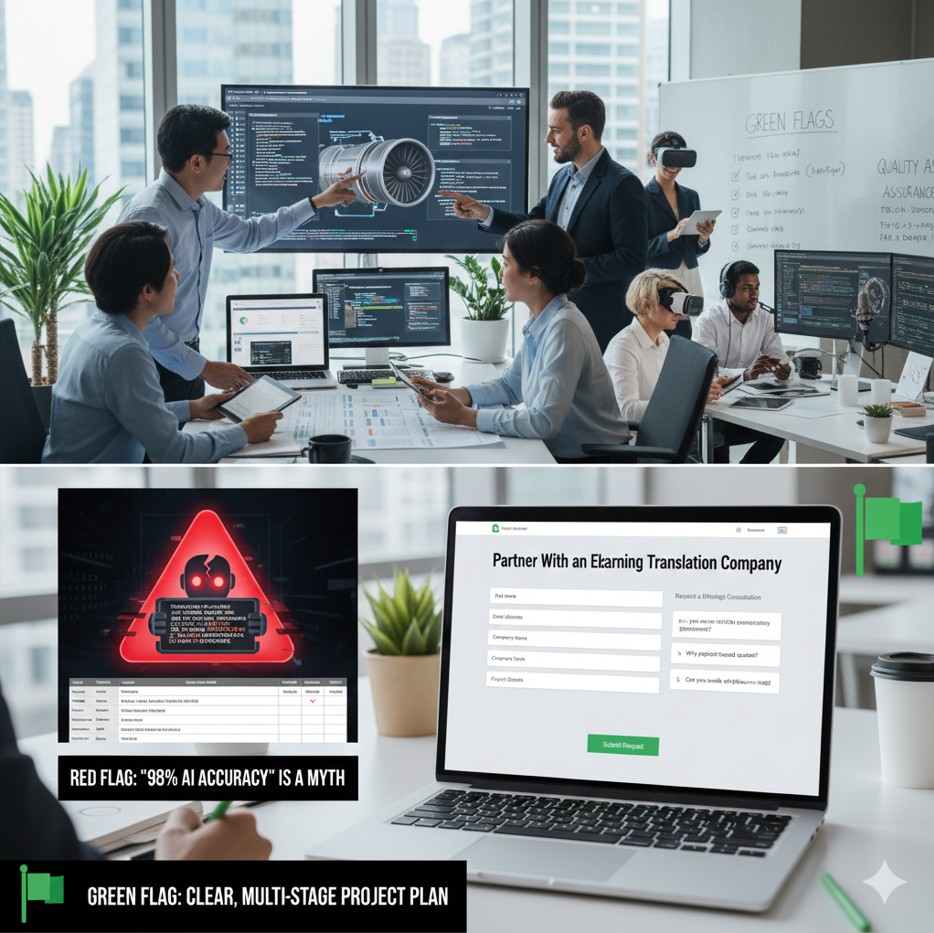
Moving Beyond the Pilot: The Decision Matrix.
Once the pilot project concludes, you must perform a formal review of the results. Whereas a minor linguistic error is easily corrected, a failure in technical logic or a lack of communication is a sign of systemic issues. A high-quality eLearning translation company will not only deliver a functional file but will also provide a report detailing the adjustments made during the localization process.
This transparency is vital. If the vendor identified a variable in your Storyline file that would not translate well into Japanese and proposed a workaround, they have proven themselves as a partner rather than a mere service provider. On the other hand, if the course returns with broken triggers or «stretchy» text that overlaps with graphics, it is a clear indicator that the vendor lacks the engineering depth required to select eLearning localization vendor status for your long-term needs.
Section 5: The ROI of Choosing a Strategic Partner.
The decision to choose eLearning translation partner organizations based on quality rather than price is a strategic investment in Human Capital. When you provide high-quality training to your global workforce, the return on investment manifests in several measurable ways.
1. Increased Knowledge Retention and Compliance.
If a learner struggles to understand the nuances of a safety or compliance course due to poor translation, the risk to the organization increases. Professional localization ensures that the instructional design remains intact across languages. This means the pedagogical «scaffolding» you built into the original course still supports the learner in the translated version.
2. Reduced Management Overhead.
A major «hidden cost» of hiring a low-quality corporate translation vendor is the time your internal team spends fixing their mistakes. If your instructional designers must spend 20 hours fixing formatting issues in a localized file, the «cheap» translation has suddenly become very expensive. A professional partner acts as an extension of your team, delivering «turnkey» files that are ready for immediate upload to your LMS.
3. Global Brand Consistency.
Your training modules are a reflection of your corporate brand. If your internal communications are polished in English but amateurish in French or German, it sends a message to your international employees that they are secondary. Ensuring that the quality of your training is consistent worldwide fosters a culture of inclusion and professionalism.
For more insights on global training strategy, visit our Oris translations E-learning pillar page.
Section 6: Future-Proofing Your eLearning Translation Strategy.
As you move forward in your eLearning translation agency selection journey, consider how your chosen partner handles the evolution of your content. E-learning is rarely static. Regulations change, software is updated, and corporate policies evolve.
The Importance of Translation Memory (TM).
A professional partner utilizes Translation Memory technology. This database stores every sentence they translate for you. When you update your course next year, the system identifies the text that has not changed, ensuring you do not pay for the same translation twice. Besides saving money, this ensures that terminology remains consistent across years of training modules. If a vendor does not mention TM or refuses to share the TM files with you, this is a significant red flag regarding their transparency.
Terminology Management and Style Guides.
Before the first word is translated, a green-flag partner will work with you to create a glossary of key terms. This is especially critical in technical industries where «jargon» must be translated exactly the same way every time to avoid confusion. Furthermore, a style guide ensures that the «voice» of your company remains authoritative and consistent across all localized versions.
To understand our approach to terminology, visit the Oris Translations specified article on E-learning QA.
Conclusion: Choosing Excellence Over Expediency.
Selecting an eLearning translation company is a decision that determines the success of your global training initiatives. By moving beyond the «price per word» mentality and looking for the Green Flags of technical engineering, cultural depth, and transparent processes, you protect both your budget and your reputation.
The Red Flags we have discussed—vague QA processes, a lack of SME translators, and an over-reliance on unedited AI—are more than just annoyances. They are risks that can lead to failed audits, safety incidents, and a disengaged global workforce. Conversely, a true partner who asks the right questions, provides a clear project plan, and invites the scrutiny of a pilot project will help you achieve the ROI your training deserves.
What sets our eLearning translation services apart is our built-in engineering team and our obsession with your course’s functional success, not just its linguistic accuracy. We understand that a course that does not work in the LMS is a course that has failed, regardless of how accurate the words may be.
Your Final Action Plan.
If you are currently evaluating vendors, we suggest you take the «Ask This, Not That» script into your next meeting. Use it to peel back the layers of sales promises and find the technical reality beneath. Finally, remember that the most successful global companies do not just translate their content; they localize the entire learning experience to empower every employee, regardless of their language or location.
Our team specializes in the most advanced authoring tools to ensure that your interactive elements remain engaging in every target language.
From Storyline variables to complex quiz logic, we handle the technical heavy lifting. This allows your internal team to focus on instructional design rather than troubleshooting files.
Request a Strategic Consultation for Your Projects.
Submit your project details to receive a comprehensive analysis of your localization requirements. Our engineers will review your files to provide a precise, project-based quotation.
Partner With an eLearning Translation Company That Prioritizes Your Global Training Success.
Reach out to our expert team today to discuss your specific localization needs. We offer tailored solutions that ensure your content resonates with every international learner.