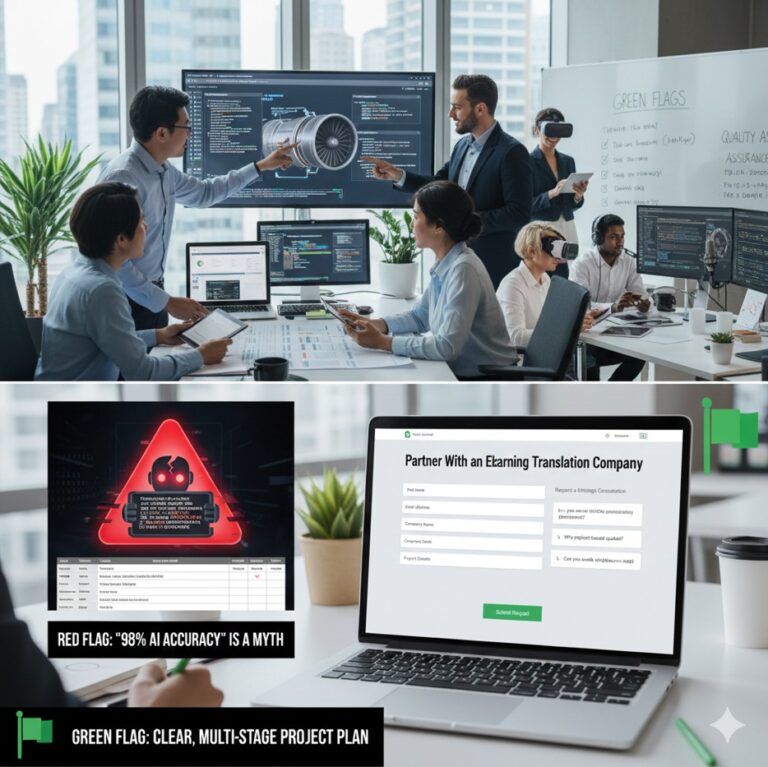
Translate Training to Global Compliance with Integrated Localization.
End the risk of poor translation. Get technically flawless, culturally relevant eLearning translation services for your global team.
We eliminate technical headaches. Our engineers ensure every localized SCORM or xAPI package functions perfectly and reports learner data accurately to any Learning Management System.
Get more than just translation. Our integrated localization adapts visuals and context, ensuring every course is culturally relevant and fully engages your international audience.
We eliminate technical headaches. Our engineers ensure every localized SCORM or xAPI package functions perfectly and reports learner data accurately to any Learning Management System.
The Shocking Truth About eLearning Translation Failures and How to Fix Them Now.
Abstract
This pillar page serves as the ultimate, definitive resource on eLearning translation services, illustrating how organizations can effectively scale their corporate training programs globally without compromising quality or compliance. Standard translation methods frequently fail when dealing with complex digital formats like SCORM, xAPI, and proprietary authoring tool files. This guide introduces Integrated Localization—a holistic, specialized approach that merges linguistic expertise, technical engineering, and cultural adaptation. We will explore the critical difference between generic professional translation services and specialized eLearning localization services, detail a rigorous, five-step translation and QA process, and showcase the specific expertise required to successfully translate eLearning courses for high-stakes industries worldwide. Our goal is to empower L&D professionals to achieve global training consistency and maximum learner engagement.
The Problem & The Opportunity (Building Empathy)
Is Your Global Training Missing the Mark?
The promise of modern digital learning—uniform quality, measurable compliance, and immediate scalability—is often broken the moment a course steps outside its original language. While a beautifully designed, engaging eLearning course might launch flawlessly in English, the localized versions often fall short, resulting in wasted budget and, more critically, fragmented learning outcomes. In today’s interconnected world, achieving global consistency is not optional; it’s a prerequisite for operational excellence and regulatory adherence.
Consider the complexity you face. You’ve invested heavily in instructional design, subject-matter expertise, and authoring tool licenses to create a master course. And then, you send it off for translation. What comes back is often a technical mess wrapped in confusing text. Further, internal teams waste countless hours correcting these errors in-country, reducing their core productivity.
Are your international teams confused by culturally irrelevant examples? A US-centric course using baseball analogies or specific regional ethical scenarios will fail to resonate, leading to low engagement and poor retention. This issue moves beyond simple word choice; it touches on the very foundation of effective cross-cultural communication. Again, when learners don’t connect with the content, they don’t retain the information, directly jeopardizing the training’s purpose.
Is your carefully crafted course functionality broken after translation? This is perhaps the most frustrating issue. Languages like German or Spanish can experience up to a 30% text expansion compared to English. This often causes text to overflow its boundary boxes, overlap graphics, or completely hide essential buttons. Besides, when the underlying code of a SCORM package is manually manipulated without expert engineering, the course can fail to track completion data in your Learning Management System (LMS), essentially making the entire training program invisible and non-compliant.
Are you wasting budget on translations that don’t improve performance? If your translated courses are technically flawed, culturally irrelevant, or linguistically inaccurate, they are not increasing competence; they are creating confusion. This is where the budget for corporate training translation is truly wasted. When the cost of correcting errors in-house (post-translation) exceeds the cost of the original translation, you have a critical process failure. You need a partner that guarantees a fully functional, culturally sound deliverable the first time.
Key Statement: Simple document translation isn’t enough. eLearning requires a specialized approach we call Integrated Localization. This holistic method ensures your course is not just understood, but resonates—technically and culturally. This is the fundamental difference between generic vendors and expert providers of eLearning translation and localization.
The opportunity, on the other hand, is immense. By adopting Integrated Localization, you unlock the full potential of your global training strategy: consistent quality worldwide, verifiable compliance, and measurable increases in learner competency, regardless of language or location.
The Core Differentiator: Why Specialized Service Matters.
The demand for multilingual eLearning development has skyrocketed, but the number of vendors equipped to handle the technical complexity has not. A general professional translation services provider excels at translating documents—manuals, contracts, or marketing copy. However, they are fundamentally unprepared for the technical requirements of an interactive, code-dependent eLearning module.
Equally important, regulatory bodies hold the course developer, not the translation vendor, responsible for the accuracy of compliance training. If an error in a safety-critical procedure is found in the localized version, the regulatory consequence falls squarely on your organization. Therefore, choosing a truly specialized partner is an act of risk mitigation.
For more information, visit our professional translation services pillar page when discussing the general benefits of choosing a dedicated language service provider.
What Are eLearning Translation Services? (Defining the Service)
More Than Words: What Are eLearning Translation Services?
eLearning translation services represent a highly technical and specialized subset of the language industry. It goes beyond linguistic conversion to encompass technical engineering, cultural adaptation, and rigorous quality assurance tailored specifically to digital learning environments. This service guarantees that the localized course functions flawlessly, looks professional, and effectively transfers knowledge to a global audience. It is a critical component of any effective multilingual eLearning development strategy.
The successful localization of a digital course requires a partner capable of managing the raw source files, handling complex multimedia elements, and understanding the tracking protocols of modern LMS platforms. This comprehensive approach is what we term Integrated Localization—the seamless convergence of all required skills into one unified workflow.
The core of our offering rests on four key pillars that differentiate specialized eLearning localization services from standard translation:
1. Linguistic Translation: Accurate, Context-Aware Text Translation.
The foundation is, of course, the text, but the standard for accuracy is exponentially higher than in general translation. Our linguists are not selected merely for their native language skills; they are chosen for their subject-matter expertise (SME) in the content area—be it finance, IT security, or advanced engineering.
- Terminology Consistency: Using a centralized, managed Translation Memory (TM) and client-approved glossary is non-negotiable. This ensures that a key technical term is translated the same way across every module, every chapter, and every quiz question. This consistency is vital for technical and compliance training where ambiguity can lead to operational errors.
- Instructional Style: The translation must retain the voice and tone intended by the instructional designer. This means adapting colloquialisms, maintaining the correct formality (especially across cultures like using Usted vs. Tú in Spanish), and ensuring the motivational elements of the training are preserved.
- Active vs. Passive Voice: In compliance and procedure training, maintaining clarity often means adhering strictly to active voice. Our linguists are trained to adapt content to meet these structural best practices, even when the source language favors a different structure.
2. Multimedia Localization: Voiceover, Subtitling, and Graphic Adaptation.
Modern eLearning rarely consists of just text. Videos, animations, and audio narrations are key drivers of engagement. To localize training materials effectively, all these elements must be handled by specialists.
- Professional Voiceovers and Dubbing: We provide professional voice talent, selected for a clear, educational delivery style. This work is meticulously timed to match the on-screen animation or video length (audio synchronization), ensuring the viewer doesn’t see mismatched visuals and sound.
- Subtitling and Captioning: Subtitles are crucial for accessibility (WCAG compliance) and for learners who are viewing content in noisy environments or prefer to read the content. Our team ensures text is correctly segmented, appears and disappears at the right time, and is formatted for maximum readability.
- Graphic Adaptation: Text is often embedded in screenshots, diagrams, and quizzes. Our Desktop Publishing (DTP) experts extract this text, translate it, and re-insert it perfectly back into the graphic element. This includes right-to-left language support (like Arabic) where the entire layout of a graphic must be mirrored.
3. Technical Integration: Handling SCORM, xAPI, and Authoring Tool Files.
This is the technical core of eLearning translation and localization. A general vendor often relies on cumbersome copy-pasting, which destroys the underlying course functionality. We bypass this risk by working directly with the source code and native project files.
- Authoring Tool Expertise: We are specialists in handling proprietary formats from market leaders like Articulate Storyline, Adobe Captivate, and Lectora. Our engineers understand the code architecture of these tools and extract text using XLIFF or XML exports, leaving the course logic untouched.
- SCORM and xAPI Preservation: Besides, we ensure that all the embedded metadata and programming that dictate how your course communicates with your LMS (SCORM/xAPI) are preserved during the re-build. The failure of this tracking function is one of the biggest risks in non-specialized eLearning localization services.
- Technical Problem Solving: Our team proactively manages text expansion, resizing text boxes, adjusting layouts, and even shortening phrasing where necessary to accommodate translation-related space changes while maintaining design integrity.
4. Cultural Adaptation: Modifying Content, Scenarios, and Visuals for the Target Culture.
Effective learning requires resonance. To truly localize training materials, the content must feel as if it were originally developed for the target learner. This is where linguistic translation evolves into cultural adaptation.
- Visual and Image Swaps: Images depicting people, clothing, or specific cultural settings (e.g., a meeting room or a street scene) are assessed and swapped with culturally relevant alternatives. This avoids distractions or, worse, unintended offense.
- Local Data and Examples: All dates, currencies, time zones, measurements (metric vs. imperial), and regional legal references are converted and adapted. Scenarios are often modified to reflect local business practices and regulatory frameworks.
- Humor and Idioms: Cultural adaptation eliminates phrases or jokes that do not translate or are culturally inappropriate, replacing them with locally equivalent or neutral phrasing. This deep level of adaptation maximizes learning engagement and retention.
For more information, visit our elearning translation services dedicated page when discussing the specific benefits and technical depth of the specialized service.
The Gold Standard in Corporate Training Translation.

Integrated localization that secures compliance and drives measurable learner outcomes.
Our process ensures consistency using custom glossaries and TM, reducing ambiguity in technical and regulatory content across all global training materials.
We handle the entire multimedia stack, providing professional voiceovers and synchronized subtitles that maintain the high quality of your source video content.


eLearning localization services that eliminate language-related training roadblocks.
Partner with us for reliable global delivery, allowing your L&D teams to focus solely on instructional design and content creation, not technical fixes.
Our Process (Building Trust through Transparency)
Our Proven 5-Step eLearning Translation Process.
In the high-stakes world of global corporate training translation, a rigorous, formalized process is your greatest assurance of quality, functionality, and compliance. Our methodology is designed to move beyond simple linguistic transfer, integrating engineering and subject-matter expertise at every stage. This repeatable 5-step process minimizes risk and guarantees a flawless deliverable, regardless of the complexity of the course content or the number of target languages.
1. Discovery & Strategy
Success begins long before the first word is translated. The Discovery phase is where we partner with your L&D and technical teams to blueprint the entire localization project.
- In-Depth Course Analysis: We analyze the source files—not just the text count, but the technical complexity: number of layers, variables, embedded media, and the specific authoring tool used. This informs the entire production plan and budget.
- Target Audience & Regulatory Audit: We pinpoint the specific cultural, linguistic, and regulatory needs for each country. Equally important, for compliance-critical training, we confirm specific regional requirements and documentation standards that must be met by the final localized version.
- Linguistic Asset Management: We review your existing Translation Memories (TM) and glossaries or establish a new custom glossary. This early step ensures maximum consistency and efficiency, forming the bedrock for all future multilingual eLearning development.
2. Linguistic & Technical Prep.
Once the Discovery phase is complete, our technical engineers take over to prepare the course files for translation. This step is crucial for separating the translatable text from the underlying code, ensuring that the course’s functionality remains completely intact. This is a core feature that distinguishes our specialized eLearning translation services from generic offerings.
- Text Extraction and XLIFF Generation: Using specialized Computer-Assisted Translation (CAT) tools, our engineers bypass the manual, error-prone copy-paste method. They extract all text, including hidden layers, alt-tags, and button text, into industry-standard formats like XLIFF or XML. This process ensures that the source code, triggers, and variables created in tools like Articulate Storyline or Adobe Captivate are entirely protected.
- Translation Memory Leverage: By running the extracted content against our existing Translation Memories (TM), we identify repeated phrases and previously translated segments. This immediately ensures maximum consistency, besides offering significant cost and time savings, especially for courses with frequent updates or shared content across modules.
- File Segmentation for Quality: Content is segmented logically for the translation team. This initial preparation allows us to provide targeted context to our linguists, minimizing guesswork and maximizing accuracy, which is essential for quality corporate training translation.
- Multimedia Scripting and Time-Coding: Further, for any embedded audio or video, the scripts are finalized, and time-codes are marked. This precise preparation guarantees that the localized voiceover or subtitles will sync perfectly with the visual elements of the course, maintaining the intended instructional rhythm.
3. Translation & Localization.
This phase is where the specialized expertise of our linguists comes into full effect. Your project is assigned to a dedicated team following the rigorous Translation-Editing-Proofreading (T-E-P) workflow, adapted for eLearning.
- SME Translation: The content is translated by a native speaker of the target language who is also a certified Subject-Matter Expert (SME) in your industry (e.g., finance, technology, or Life Science). This dual expertise guarantees that technical terminology, regulatory jargon, and industry-specific concepts are translated with absolute accuracy. This level of specialization is why organizations choose us over general professional translation services.
- Independent Editing and Verification: An independent second linguist reviews the entire translation against the source text. This editor meticulously checks for semantic accuracy, stylistic consistency, and adherence to the client’s approved glossary. The goal here is to refine the language, ensuring it sounds natural and fluent to a native audience, completely eliminating «translationese.»
- Cultural Adaptation Integration: During this process, the linguist ensures that all scenarios, examples, and graphical elements mentioned in the text are culturally appropriate for the target market. This step is vital to truly localize training materials and ensure the instructional content resonates, driving higher learner engagement.
For more information about the depth of our specialized expertise, visit our dedicated elearning translation services page.
4. QA & Engineering Rebuild.
The QA and Engineering phase is the critical link between linguistic accuracy and technical functionality. This is the stage that directly addresses the common pain points—broken SCORM files and visual formatting issues—that plague non-specialized eLearning translation and localization.
- Reverse Engineering and Re-Import: Our engineers take the translated XLIFF files and re-import them back into the original authoring tool (e.g., Storyline). During this process, they proactively manage text expansion, which is a major factor in multilingual eLearning development. They adjust text boxes, reposition graphics, and modify layouts to accommodate longer translated phrases, preventing text overflow and maintaining the aesthetic design.
- Functional Testing: This is a non-negotiable step. The newly localized course is subjected to comprehensive testing on virtual machines that simulate real-world user environments. We check every interactive element: buttons, links, quizzes, knowledge checks, drag-and-drops, and software simulations. Besides, we verify that the course properly initializes and reports data to various LMS environments, ensuring compliance with SCORM, xAPI, and cmi5 standards.
- Linguistic In-Context Review (L-ICR): Finally, a native-speaking linguist reviews the published, functional course on the LMS player. They check for contextual errors that only become visible in the final format (e.g., a short phrase translated correctly in isolation, but making no sense when displayed on a button). This final check guarantees that the user experience is flawless.
5. Final Review & Delivery.
The final step is the reliable delivery of a fully certified, ready-to-use learning package.
- Client Review and Sign-Off: The fully functional, localized course is provided to your internal stakeholders for a final review period, ensuring complete satisfaction before final delivery.
- Archiving and Asset Management: Again, upon project completion, all linguistic assets—the updated Translation Memory and the final, approved glossary—are securely stored. This ensures that any future updates, revisions, or expansion into new languages will be faster, cheaper, and perfectly consistent, dramatically reducing your long-term translate eLearning courses costs.
- Delivery Formats: We deliver the complete package in the format you need: ready-to-upload SCORM packages, published video files, or the raw source files from the authoring tools, depending on your internal workflows.
Industries & Solutions We Serve (Demonstrating Versatility).
eLearning Localization Services for Your Industry.
While we have specialized expertise in high-stakes fields, our eLearning translation and localization solutions are versatile, supporting any organization looking to scale its training globally. We understand that effective corporate training translation is highly industry-dependent; the terminology and compliance concerns of a financial institution are vastly different from those of a technology firm. Our team structure is built to match this diversity, ensuring you always work with a team that speaks your industry’s language.
The power of multilingual eLearning development is its adaptability. We ensure that your critical training content—from mandatory compliance modules to complex software simulations—is accessible and engaging to every single employee, partner, or customer around the world.
- Corporate Training: This foundational area includes mandatory compliance training (e.g., GDPR, anti-harassment), leadership development programs, and human resources onboarding modules. We help clients transform internal policy guides and regional legal training into universally understood and legally sound localized content.
- Academia & MOOCs: University-level content and Massive Open Online Courses (MOOCs) demand accuracy, particularly in scientific and technical disciplines. We assist educational institutions in making their curriculum accessible to a global student body, managing the conversion of large video lecture libraries and complex technical handouts.
- Healthcare & Life Sciences: This is our area of greatest specialization, requiring the highest level of accuracy and regulatory knowledge. This includes patient education modules, clinical research protocols, and detailed medical device operation training. The consequences of error here are severe, demanding SME linguists and ISO-certified quality processes.
- Technology & SaaS: For Software-as-a-Service (SaaS) companies, training often involves hands-on product usage. We localize training materials for software simulation courses, onboarding tutorials, and technical support guides, ensuring that all UI elements are consistent with the translated software interface. This consistency is essential for rapid product adoption globally.
Beyond these major categories, our expertise extends to specialized needs like financial services (AML/KYC training), energy and utilities (safety protocols), and the manufacturing sector (machinery operation and maintenance training). For every project, our process starts by aligning our professional translation services with your industry’s specific compliance demands, ensuring the final localized training is both technically accurate and legally sound.
For more information, visit our detailed article about How to Choose an eLearning Translation Company.
We are specialists in SCORM, xAPI, and proprietary authoring tool architecture.


Avoid failed launches. Our technical QA includes in-depth testing on simulated LMS environments to ensure localized variables and tracking data report correctly every time.

Our Technology Expertise (Technical SEO & Credibility).
We Work With Your Authoring Tools and Platforms.
The biggest single point of failure in standard eLearning translation and localization is technical incompatibility. A provider might deliver linguistically perfect content, but if that content breaks the structure of your Articulate Storyline project or fails to correctly report to your Learning Management System (LMS), the entire localization investment is useless.
Our methodology is built upon technical integration. We don’t ask you to simplify your courses; we ensure our engineering expertise meets the complexity of your source files. This proactive approach saves hundreds of hours of debugging and rework, guaranteeing a truly seamless transition when you translate eLearning courses to new languages.
This specialized technical proficiency is what sets us apart from generic elearning localization services. We are not just translators; we are course engineers.
Authoring Tools: We Speak Your Software’s Language.
To successfully handle text expansion and maintain complex triggers and variables, we must work directly with the native project files. Our engineers maintain active licenses and deep, certified expertise in all major authoring tools.
- Articulate Storyline: We expertly handle the localization of complex Storyline projects, managing variables, triggers, layers, and text expansion in the raw .story file. This ensures interactive elements function perfectly in every language.
- Adobe Captivate: Our team is proficient in managing Captivate’s unique structure, including its approach to software simulations and responsive design, crucial when you need to translate eLearning courses optimized for different devices.
- Lectora: We manage localization within the Lectora platform, often used for its compliance-heavy capabilities, ensuring regulatory content is handled correctly during translation and testing.
- Custom HTML5/JavaScript: Further, for custom-developed courses, our developers work directly with the underlying code, using sophisticated text extraction methods to protect all scripting and programming logic.
LMS Platforms: Guaranteed Interoperability.
Your LMS is the delivery and reporting hub for your global training. The localized course must perform flawlessly regardless of your platform. Our testing protocols verify compatibility across the major systems.
- Docebo & Cornerstone: We specialize in integration testing for large, enterprise-level LMS platforms, ensuring the course tracking and completion data are accurately passed back and recorded.
- Moodle, SuccessFactors, & Custom Systems: Again, we ensure interoperability across open-source and proprietary platforms, testing the final published package in a dedicated QA environment before delivery to you.
File Formats: Compliance and Tracking Standards.
The integrity of your tracking data is paramount, especially for compliance training. We are experts in localization for all current and legacy e-learning standards.
- SCORM: We guarantee that our localized content meets all SCORM standards (1.2, 2004), ensuring reliable communication between the course and the LMS. SCORM translation requires precision to prevent data loss.
- xAPI (Tin Can API): For modern, experience-based learning that tracks activity outside the traditional LMS, we ensure the translated content correctly formats and sends Experience API statements.
- cmi5 & MP4: Besides, we handle localization for the newest standards and simple video formats, ensuring consistency across your entire content library, regardless of the format you choose to localize training materials in.
Text: «Our engineers are certified experts in these platforms, ensuring a seamless transition from your original source to any translated version. This technical assurance is the foundation of our eLearning translation and localization guarantee.»
Why Choose Oristranslations? (Your Unique Value Proposition).
Why Leading Companies Trust Oristranslations for eLearning Localization Services.
Choosing a partner to localize training materials for your global workforce is a strategic decision that impacts compliance, performance, and budget. Generic professional translation services simply cannot match the specialized workflow, technical proficiency, and high-stakes expertise we bring to every project.
Our commitment to Integrated Localization means we provide a comprehensive, end-to-end service that de-risks your global expansion and guarantees functional, engaging, and accurate training delivery.
Subject-Matter Expert Translators: The Highest Standard of Accuracy.
The stakes are too high for generalists. For complex corporate training translation—especially in regulated industries—our linguists are more than just native speakers; they are industry veterans.
- Industry-Specific Knowledge: «All our linguists have industry-specific knowledge.» This ensures technical and clinical terminology is perfect, reducing the costly in-country review process.
- Vast Global Network: We maintain a curated network of translators, allowing us to staff large-scale, multilingual elearning development projects quickly while preserving quality across all languages.
Robust Quality Assurance: Eliminating Risk.
Our multi-stage quality protocol is designed to catch errors at every potential failure point—linguistic, technical, and cultural. We adhere to the highest international quality standards for translation and localization.
- Multi-Stage T-E-P Workflow: The core Translation-Editing-Proofreading model is augmented with technical QA and the final Linguistic In-Context Review (L-ICR).
- Guaranteed Functionality: «A multi-stage QA process checks for linguistic accuracy, technical functionality, and cultural fit.» We guarantee the delivered SCORM/xAPI package will work on your LMS.
Fast, Scalable Turnaround: Meeting Tight Global Deadlines.
Scaling your training requires speed, but never at the expense of quality. Our technology and project management methods are optimized for rapid, high-volume delivery.
- Dedicated Project Management: «Leverage our dedicated project management and translation technology to meet your deadlines.» You work with a single, experienced point of contact who manages all languages and technical issues.
- Translation Memory (TM) Leverage: Our smart use of TM ensures that when you update existing courses, the translation process is dramatically faster and cheaper, allowing for rapid deployment of critical updates.
Security & Confidentiality: Protecting Sensitive Training Data.
We understand that corporate training translation often involves highly sensitive and proprietary data, from HR policies to R&D findings. Data security is paramount throughout our entire process.
- Certified Security Protocols: «We are GDPR compliant and adhere to strict data security protocols.» Our secure servers and file handling procedures ensure your proprietary information is protected throughout the localization workflow.
- Confidentiality Agreements: All linguists and technical staff are bound by strict non-disclosure and confidentiality agreements tailored to high-stakes industries.
Further, when evaluating vendors for specialized eLearning localization services, one must always consider the long-term partnership. Our focus is on building translation assets (T-M, glossaries) that make your next project faster and less expensive. This long-term cost reduction is where true value lies.
Secure high-stakes training accuracy by utilizing verifiable industry-specific linguists on every project.


Only professional translation services with certified SMEs can meet the demands of regulated multilingual eLearning development.
Decoding Technical Risk: SCORM Translation and Tracking.
The true measure of quality in eLearning translation services is not just linguistic accuracy, but technical fidelity. For most Learning and Development (L&D) managers, the fear of a broken SCORM file is a constant source of anxiety. SCORM (Sharable Content Object Reference Model) and its modern successor, xAPI, are the rulesets that allow your course to communicate with your LMS, reporting essential data like completion, scores, and time spent. If the translation process disrupts this communication, the training instantly loses its compliance and reporting value.
Why Generic Vendors Break SCORM Translation.
Generic professional translation services typically fail this technical test for several core reasons:
- Code Blindness: They treat the course files as simple documents, manually extracting and re-inserting text without understanding how embedded code, variable names, or file paths function. This often introduces syntax errors or breaks necessary code structures.
- Character Set Conflicts: Different languages require different character sets (e.g., Arabic, Cyrillic, or CJK characters). If the translation tools or the LMS aren’t configured correctly, these characters can corrupt the file’s XML structure, immediately causing SCORM communication to fail.
- Text Expansion Fallout: As noted earlier, languages expand. If the layout shifts or text overlaps, the course sometimes encounters runtime errors. More critically, text that overflows a graphic may lose necessary instructions or buttons, causing the learner to be unable to proceed, which incorrectly flags the course as incomplete.
Our Technical Solution: Guaranteed Functionality.
Our approach to elearning localization services is to treat the source file as an engineering project first. We deploy a proprietary pre-and-post-translation technical QA process to address these failure points proactively. This includes:
- XLIFF-Only Workflow: We use specialized CAT tools to generate XLIFF files, which safeguard the original code structure by separating the translation content from the markup. This is the only reliable way to manage SCORM translation at scale.
- LMS Simulation Testing: Furthermore, every finalized localized course is tested across a range of simulated LMS environments. We verify that the course correctly initializes, tracks all quiz results, and successfully reports the final completion status back to the simulated server, guaranteeing it will work on your production system.
- Debugging Expertise: Again, our engineers are specialists in debugging issues specific to multilingual eLearning environments. They can diagnose and repair errors caused by text wrapping, character encoding conflicts, and broken triggers, saving your internal IT team significant time and frustration.
Strategic Impact: Multilingual eLearning Development as a Growth Driver.
The cost of eLearning translation and localization should not be viewed as an expense, but as a strategic investment in global market penetration and employee competency. High-quality corporate training translation directly contributes to several key performance indicators (KPIs) and business goals.
Reducing Compliance and Legal Exposure.
In highly regulated sectors, inaccurate training is a direct liability. By using specialized elearning localization services, you demonstrate due diligence in training your workforce or partners according to local safety and legal standards.
- Verifiable Training: When you localize training materials with guaranteed technical and linguistic accuracy, the training completion data in your LMS becomes a verifiable record of legal compliance in any jurisdiction.
- Risk Mitigation: Besides, ensuring that complex instructions, like those for machinery operation or financial reporting, are perfectly clear in all languages dramatically reduces the risk of operational errors, lawsuits, and fines related to non-compliance.
Maximizing ROI Through Learner Engagement.
If learners are disengaged, the investment in content creation is wasted. The cultural relevance achieved through professional eLearning translation and localization directly impacts the effectiveness of the training.
- Increased Retention: Equally important, courses that use familiar scenarios, culturally appropriate visuals, and native-sounding voiceovers lead to higher learner comfort and superior information retention. Learners aren’t spending cognitive energy trying to decipher awkward phrasing or irrelevant metaphors.
- Reduced Training Time: When learners immediately grasp the content, the required training time and the need for expensive, time-consuming follow-up training sessions are dramatically reduced, accelerating time-to-competency.
Scalability and Speed to Market.
In a competitive global environment, speed matters. The ability to launch training in multiple languages simultaneously gives your company a competitive advantage.
- Centralized Efficiency: By partnering with us for professional translation services, you centralize a complex, multi-faceted process (translation, engineering, testing, multimedia) into a single, efficient workflow, allowing you to launch new products or policy updates globally in parallel.
- Future-Proofing Content: Finally, our creation and management of your translation assets ensure that as your company expands and you need to translate eLearning courses into new languages or update existing ones, the process is streamlined and cost-effective, supporting rapid business growth.
The strategic choice to invest in high-quality eLearning translation and localization is reflected directly in employee performance, global brand consistency, and, ultimately, your bottom line. Organizations that view multilingual eLearning development as a core strategic function will consistently outperform those that treat translation as a mere checkbox activity.
The partnership with a specialized provider allows your internal L&D and compliance teams to focus on creating world-class source content, while we guarantee its flawless global delivery. This synergistic approach maximizes the effectiveness of your educational investment and elevates the reputation of your entire training organization.
Ready to Take Your Training Global?.
You have seen the technical complexity of SCORM translation, the necessity of cultural adaptation, and the critical need for professional translation services that truly specialize in eLearning localization services. The risk of relying on generic vendors—broken courses, technical failures, and compliance gaps—is simply too high for modern enterprises.
Further, whether you are looking to translate eLearning courses for a pilot program in two languages or launch a massive corporate training translation initiative across twenty countries, our integrated team is ready to deliver flawless results.
For more information about how we streamline enterprise projects, visit our professional translation services pillar page when discussing the general benefits of choosing a dedicated language service provider.
Frequently Asked Questions About eLearning Translation Services
Q: How do your eLearning localization services manage text expansion without breaking the course design?
- A: Our technical engineers proactively manage text expansion during the QA and Engineering Rebuild phase. This involves analyzing the source file for potential overflow before translation, adjusting text boxes and button sizes after translation, and sometimes providing minor text optimization (shortening phrases) to maintain the aesthetic and functional design. This is standard procedure for eLearning translation and localization.
Q: What is the difference between general translation and your specialized eLearning translation services?
- A: General translation handles text documents; specialized eLearning translation services handle complex, dynamic code packages (SCORM/xAPI) and multimedia. We focus on four pillars: linguistic accuracy, technical functionality, cultural relevance, and certified QA. This ensures the course not only reads right but works right on your LMS.
Q: Which LMS platforms and authoring tools are you compatible with?
- A: We work with all major tools including Articulate Storyline, Adobe Captivate, and Lectora. Our localized courses are tested for compatibility with enterprise LMS platforms like Docebo, Cornerstone, Moodle, and SuccessFactors, guaranteeing successful tracking and reporting across any system.
Q: How can I reduce the cost of my multilingual eLearning development projects?
- A: Cost reduction is achieved primarily through effective use of Translation Memory (TM). By storing previously translated and approved content, we leverage existing work, ensuring you only pay for new content. This makes course updates and new language rollouts significantly cheaper and faster.
Q: Is your corporate training translation service compliant with global regulations like GDPR or local labor laws?
- A: Yes. When we localize training materials related to legal and compliance issues, we work with specialized legal and HR subject matter experts (SMEs). The cultural adaptation phase ensures that local laws and customs are accurately reflected in the training content and scenarios.
Q: What is an L-ICR, and why is it essential for eLearning localization?
- A: L-ICR stands for Linguistic In-Context Review. It is a final quality assurance step where a native speaker reviews the published, functional course (not just the text file) within the LMS player environment. This catches contextual errors, visual glitches (text overlap), and flow issues that only become apparent in the final user interface.
For more information about the depth of our specialized expertise, visit our dedicated elearning translation services page when discussing the technical, functional, and quality benefits of our specialized service.
Conclusion: Your Global Training Partner The path to truly global training is paved with technical precision, linguistic accuracy, and cultural insight. By choosing Oristranslations, you are selecting a partner whose expertise goes beyond simple translation, offering a comprehensive Integrated Localization solution. This approach is your guarantee that your meticulously designed training will maintain its integrity, functionality, and impact, driving measurable improvements in competency and compliance across your entire international organization. Stop managing risk and start mastering your global training strategy today.
End the risk of poor translation. Get technically flawless, culturally relevant eLearning translation services for your global team.
Partner with professional translation services that are engineering experts in SCORM, xAPI, and the unique demands of regulated corporate training translation.
Have Questions Before You Start?
Our team is here to guide you through the complexities of eLearning localization services, course preparation, and securing global training compliance.
Ready to Launch Compliant, Functional Training in Any Language?
Stop relying on generic professional translation services. Consult with our eLearning translation services experts to secure your global training compliance and quality today.